On a spiral notebook, the cover is the part that survives being shoved in a bag, dragged across a desk, and opened a few thousand times on its coil. The pages carry the writing, but the cover carries the brand and takes nearly all of the wear. Choosing its material and finish is where a custom order either feels cheap or feels considered, and it is the decision most buyers spend the least time on. This guide walks through the cover stocks in common use, what the weight numbers actually mean, and how the finish changes both durability and look.
The two families: printed board and wrapped rigid covers
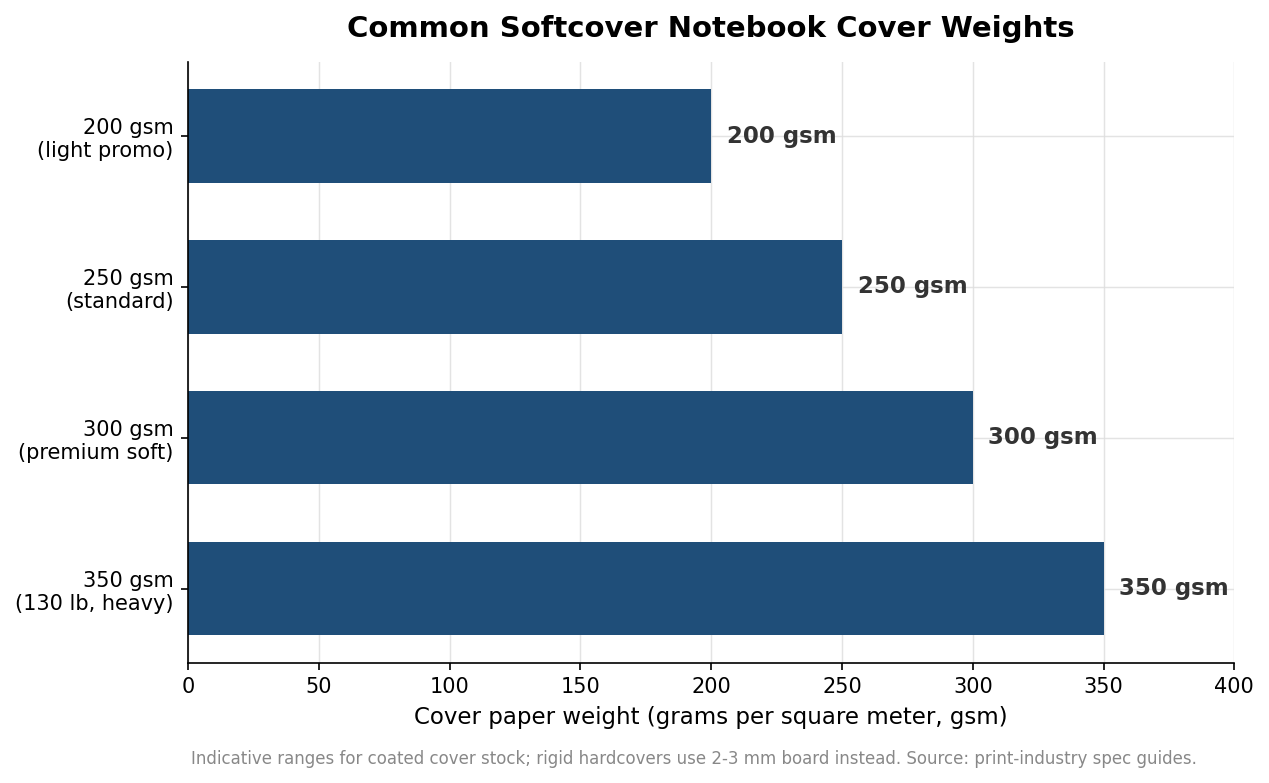
Almost every custom spiral notebook cover falls into one of two families. The first is a printed cover stock, a single sheet of coated cardboard printed directly with your artwork and then usually laminated. This is what you see on promotional and school notebooks: light, flexible, inexpensive, and fully printable edge to edge. Cover weights here typically run from about 200 gsm for a light promotional cover up to 300 gsm for a premium softcover that resists curling. Heavier grades around 350 gsm (roughly a 130 lb cover) feel almost like a thin board and hold up better to repeated bag abuse.
The second family is a wrapped rigid cover, built around a 2 to 3 mm gray board and then wrapped in a thinner printed sheet, cloth, or artificial leather. A common construction is 157 gsm coated art paper wrapped over 2 to 3 mm board, which gives the hardcover feel of a journal rather than a notebook. Cloth and leatherette wraps push further toward a premium, gift-grade product and pair naturally with foil stamping or debossing instead of full-color printing.
Reading the weight numbers without getting lost
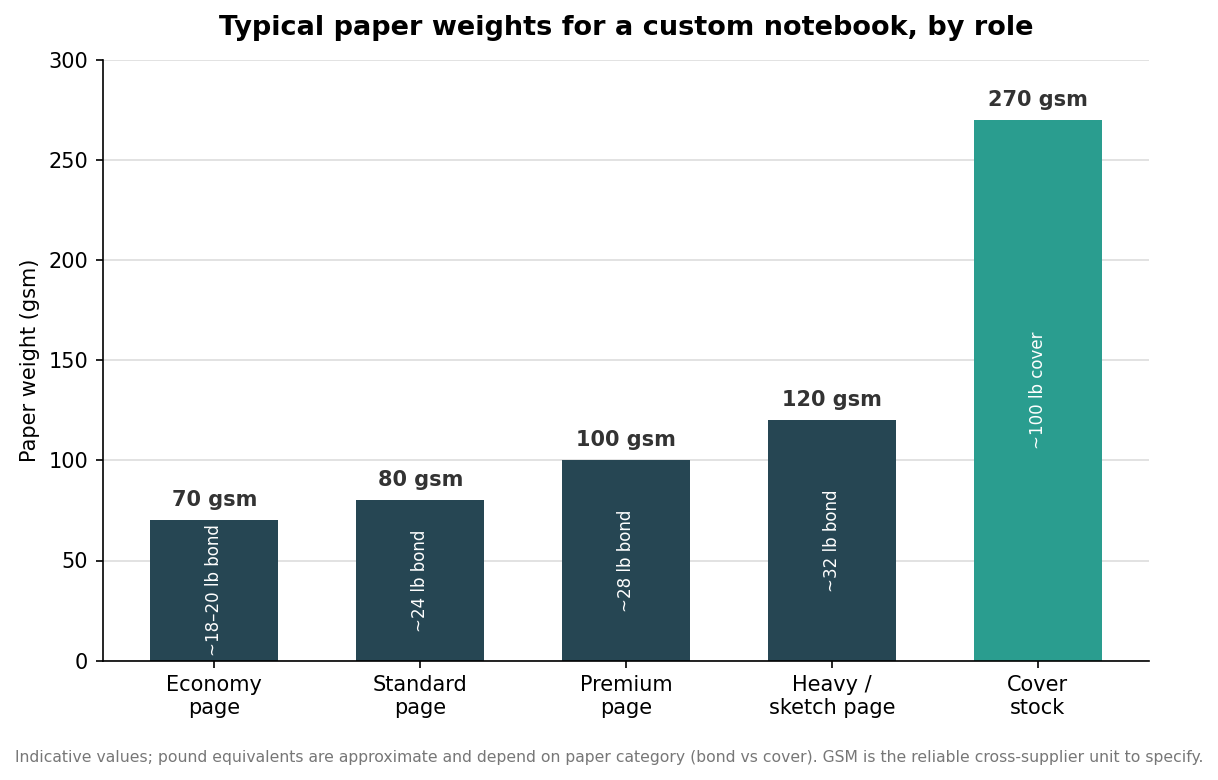
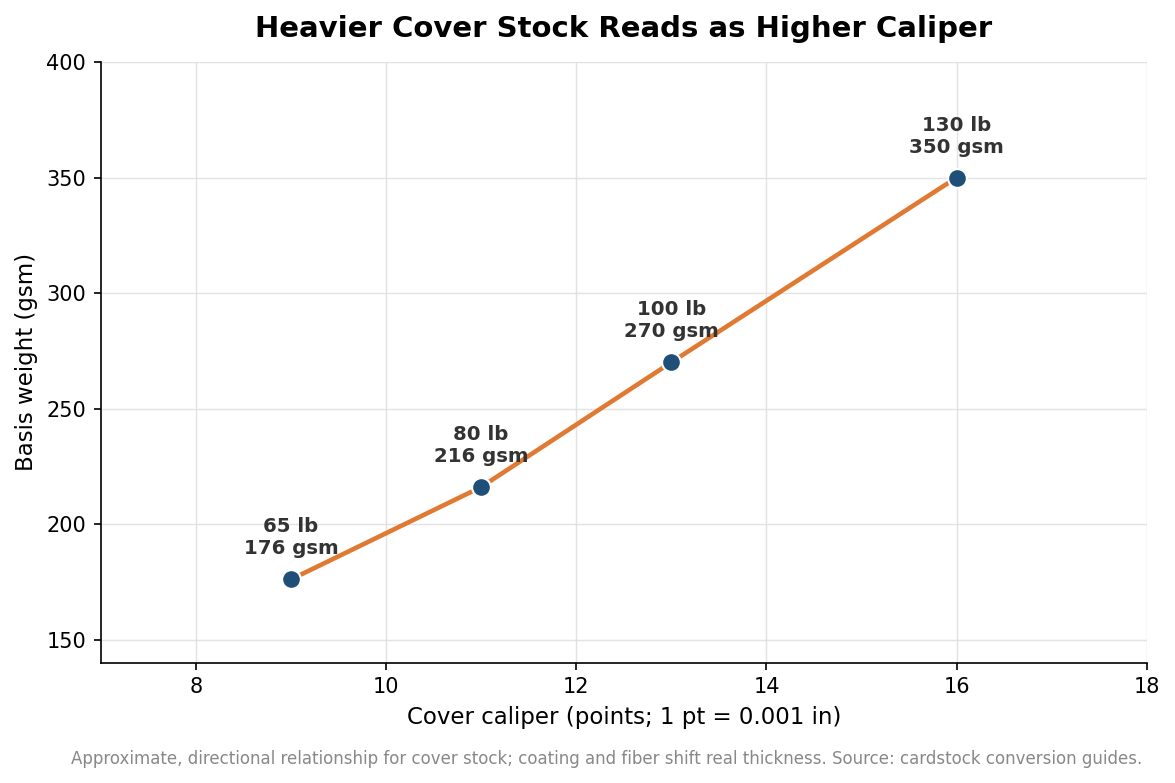
Cover stock gets described three different ways depending on who is talking: grams per square meter (gsm), pounds (lb cover), and points (pt) of caliper. They measure related but not identical things. Gsm and lb are weight; points are thickness, where one point equals one-thousandth of an inch. As a directional rule, a 65 lb cover lands near 176 gsm and 8 to 10 pt, an 80 lb cover near 216 gsm and 10 to 12 pt, a 100 lb cover near 270 gsm and 12 to 14 pt, and a 130 lb cover near 350 gsm and 16 pt or more.
The important caveat is that these conversions are approximate. Two sheets with the same gsm can feel noticeably different once coating, fiber, and calendaring are factored in, so a printed sample is worth more than any chart. Use the numbers to narrow the range, then confirm the feel in hand before you commit to a large run.
Plastic, kraft, and the specialty covers
Beyond paper, a few specialty covers solve specific problems. Poly or PVC plastic covers are the toughest option a softcover notebook can carry: they shrug off water, resist scuffing, and survive field and shop use that would shred a paper cover. They print well in solid colors and can be translucent for a frosted look, though photographic artwork reproduces better on coated paper. Expect a flexible plastic cover to add a small amount of thickness and cost over a standard printed stock.
Kraft or chipboard covers go the other direction: an unbleached, natural-brown board with a matte, recycled look that suits eco-minded and minimalist branding. They take one- or two-color printing and foil beautifully but are not the surface for a full-bleed photo. Cloth and leatherette, as noted, sit at the premium end and are typically reserved for gift and executive notebooks where the tactile impression justifies the cost.
Finish is half the decision
Whatever the base material, the finish determines how the cover feels and how long the print survives. Gloss lamination makes colors pop and adds water and scuff resistance, which is why it is the default on promotional runs. Matte lamination reads as more upscale and hides fingerprints, at the cost of some color vibrancy. A soft-touch or velvet laminate adds a suede-like feel that buyers consistently associate with premium products. On top of any of these, spot UV, foil stamping, embossing, and debossing add selective contrast, most effectively when used sparingly on a logo rather than across the whole cover.
Match the finish to the use. A notebook that will live outdoors or in a bag benefits from gloss or plastic and a laminate that seals the print; a corporate gift is better served by matte or soft-touch with a foil mark. Lamination also matters structurally, because it is what keeps the printed cover from absorbing moisture and delaminating at the coil holes over time.
Specifying it cleanly
To get an accurate quote and avoid surprises, state the cover as a material plus a weight plus a finish: for example, 300 gsm coated stock, matte laminate, with spot UV on the logo, or 2.5 mm board wrapped in charcoal cloth with silver foil. Supply artwork as a CMYK PDF at 300 dpi with a 3 mm bleed so the printed cover trims cleanly at the edges. Pairing a considered cover with the right interior paper, usually 80 gsm for everyday writing, 100 gsm to cut show-through, and 120 gsm or more for marker and sketch use, is what makes a custom notebook feel finished rather than merely printed. When in doubt, order a physical proof; the cover is the one component where the difference between two similar specs is something you can only judge by holding it.