The binding is the one decision on a custom spiral notebook you cannot change after the fact. Cover art can be reprinted and paper can be swapped, but the way the pages are held together shapes how the notebook opens, how many sheets it can carry, how it survives a backpack, and what it costs per unit. Three methods dominate custom work, and they are not interchangeable. Here is how plastic spiral coil, twin-loop Wire-O, and plastic comb actually differ, and how to match one to your project.
The three ways a notebook gets bound
Plastic spiral coil is a single continuous plastic filament spun through a row of small punched holes, almost always at a 4:1 pitch, meaning four holes per inch. It is the default for custom notebooks because it is durable, comes in a wide range of colors to match a cover, and is inexpensive at volume. Twin-loop Wire-O uses pairs of pre-formed metal loops crimped closed through the holes. It reads as more formal and polished, with a clean metallic spine. Plastic comb is the flat plastic spine with curled teeth you have opened by hand on a report; its advantage is that it can be reopened to add or remove pages, and the wide spine can be printed with a title.
All three let a book open flat, but they do not all behave the same once it is open or once it is dropped.
How coil diameter sets your page count
With coil binding, the diameter of the coil is what caps your page count, and the relationship is close to linear. A slim 6mm coil holds around 30 sheets of standard 20lb paper; a 10mm coil takes about 75; 15mm reaches roughly 125; and the large 50mm coils used for thick manuals carry up to about 440 sheets. Pick a coil that matches the book with a little headroom, because a coil packed to its absolute maximum binds stiffly and does not turn cleanly.
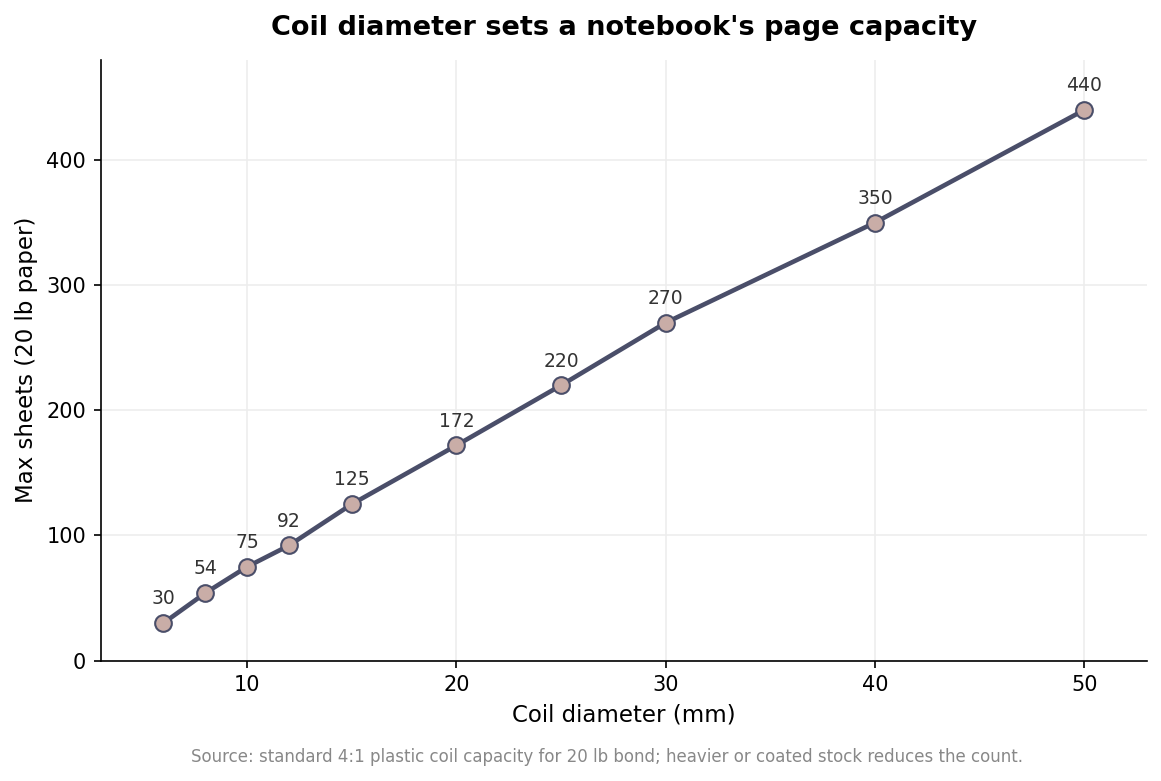
Two things shift those numbers. Heavier or coated stock takes up more room than plain 20lb bond, so a notebook printed on thick cover-weight paper will hit the coil’s limit at a lower sheet count than the chart suggests. And the coil diameter you choose also sets how far the pages can splay open, so a slightly larger coil than the minimum often turns and lies flat more comfortably. Treat the capacity figure as a ceiling to stay under, not a target to hit.
Lay-flat, durability, and the trade-offs
All three bindings open flat, and both coil and Wire-O let the pages wrap a full 360 degrees so the notebook folds back on itself, which comb binding does not do well. The real separation is durability under abuse. Plastic coil is springy: crush it in a bag and it tends to rebound to shape. Wire-O is metal, so it looks sharper but can be bent or crushed permanently if the notebook is dropped on its spine or crammed into a full backpack, and a flattened wire is hard to fix. Comb is the least rugged of the three and is better suited to documents that live on a desk than to field use.
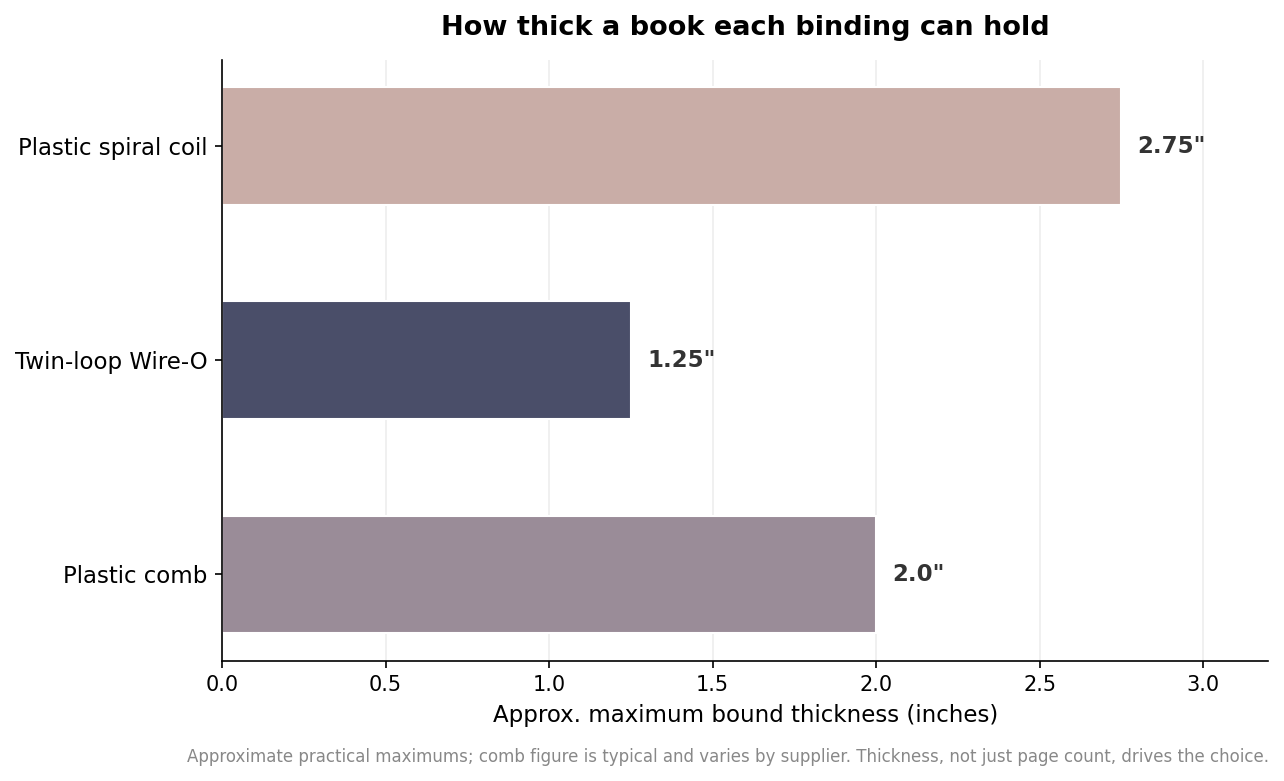
Capacity also differs by more than page count. Coil handles the thickest books, up to roughly two and three-quarter inches; comb manages up to about two inches; and Wire-O is best kept to around an inch and a quarter, above which the loops struggle to turn heavy page stacks cleanly. If your notebook is thick, coil is usually the practical answer.
Cost and the small details
On price, coil and comb sit in the affordable range and Wire-O commands a premium for its metal and its more involved closing step. Comb is the only one of the three that is genuinely editable after binding, since you can reopen the spine to insert or pull pages, which matters for manuals that get revised. Coil and Wire-O are effectively permanent once closed. Color is another quiet differentiator: plastic coil comes in dozens of shades and can be matched or contrasted to a cover for a branded look, while Wire-O is typically limited to metallic finishes like black, silver, white, and bronze.
One production note worth planning for: every one of these bindings punches holes along the binding edge, so keep important cover and page artwork clear of that margin. Text or logos placed too close to the punch line get clipped by the holes. A safe clearance of at least a quarter inch from the bound edge keeps your design intact.
Matching the binding to the job
For most custom notebooks, journals, planners, and workbooks that need to survive daily carry, take a logo-matched spine color, and open fully flat, plastic spiral coil is the sensible default, and it scales to thick page counts that the others cannot. Choose twin-loop Wire-O when presentation is the priority and the book will be handled carefully, such as a premium planner, a proposal, or a photography piece where the metallic spine signals quality. Choose plastic comb when you specifically need to add or remove pages later, or want a printable spine, and the book will live somewhere gentle. Decide the use case first, then let page count and thickness point you to the diameter, and confirm the pitch and clearance with your printer before you approve artwork.