Two specs decide how a custom spiral notebook feels in the hand and whether it survives a semester or a sales year: the weight of the paper and the size of the coil. Buyers spend a lot of time on cover art and almost none on these, then wonder why pages feel flimsy, ink ghosts through, or the finished book barely closes around an overstuffed coil. Both specs are simple once you know the units and the tradeoffs. This walkthrough shows how to choose a page weight, a cover weight, and a coil diameter that match how the notebook will actually be used, and how to hand a supplier numbers instead of adjectives.
Paper weight, in the units that matter
The first source of confusion is the units. US suppliers quote paper in pounds, but a pound figure only means something alongside the paper category, because a pound of bond and a pound of cover are measured on different base sheets. A far more reliable unit is grams per square meter, or GSM, which describes the same physical weight regardless of paper type. When you specify a notebook, give the GSM and you remove the ambiguity. As a rough translation, 20-pound bond is about 75 GSM, 24-pound bond about 90 GSM, and 28 to 32-pound bond lands around 100 to 120 GSM, while cover stocks run from roughly 175 GSM at 65-pound cover up to 350 GSM at 130-pound cover. The chart below shows the weights that matter for a notebook.
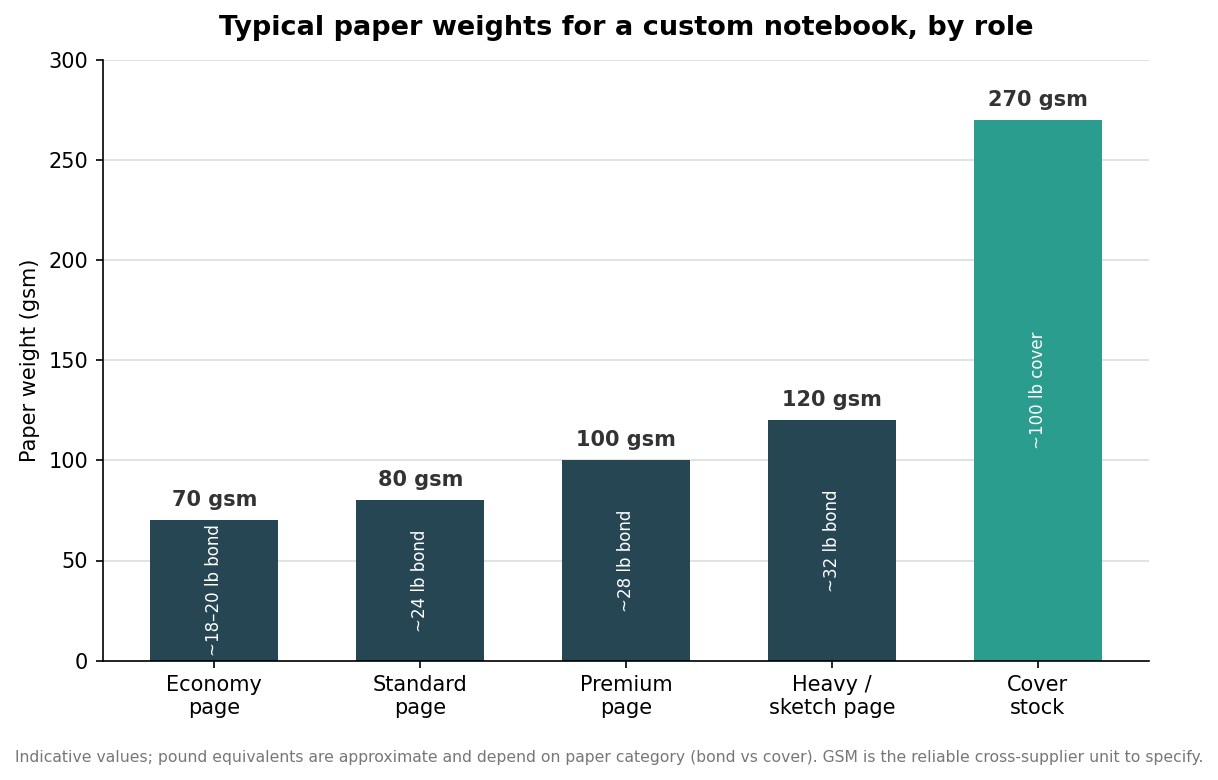
Read the pound equivalents as approximate and the GSM as the number to actually put on your order. The single most useful habit when comparing quotes from two suppliers is to convert everything to GSM first, because otherwise you can be comparing a 24-pound bond page against a 24-pound text page and not realize they are different sheets.
Choosing the page weight for how the notebook is used
Page weight is where writing feel and show-through are decided. Economy pages around 70 GSM keep unit cost and shipping weight down and are fine for high-volume giveaway notebooks that will be used lightly with pencil or ballpoint. Standard pages at 80 GSM are the sensible default for everyday writing and the weight most people picture when they think of a notebook. Premium pages at 90 to 100 GSM noticeably reduce ghosting and stand up to gel pens and light marker use, which matters for a branded notebook meant to feel considered. Heavy pages at 120 GSM approach sketchbook territory and handle fountain pen and light wash without bleed, at a real cost in thickness and price.
The practical rule is to weight the page to the pen. If your users write with fountain pens, gel pens, or markers, spend up to at least 90 to 100 GSM to control show-through, which is the most common complaint about cheap notebooks. If the book is a promotional item that will mostly sit on a desk, 70 to 80 GSM saves money that is better spent on the cover, which is the part people see. Do not over-buy weight for its own sake, because heavier paper also cuts how many sheets fit inside a given coil, which we come to below.
The cover and the back board
The cover carries the brand and takes the abuse, so it is worth a distinct spec. A soft printed cover in the range of 250 to 300 GSM cover stock, often with a matte or gloss laminate, gives a durable, professional face without adding much bulk. Lighter cover stock around 175 to 216 GSM feels closer to a heavy page and suits inexpensive books, while a genuinely rigid feel calls for either a heavier laminated cover or a chipboard-backed construction. The back is easy to forget: a stiff chipboard or heavy cover back gives the notebook something to write against when it is held in one hand, which is a large part of why a book feels solid or cheap. Specify the cover and back weights separately from the pages, because they are different papers doing different jobs.
Matching coil size to page count
Once the paper is chosen, the coil has to fit around the finished thickness. Plastic coil is sold by diameter, and each diameter has a maximum sheet capacity assuming standard 20-pound paper. Undersize the coil and the book will not close or the pages will not turn; oversize it and the pages slide and the book gaps open. The line below maps common coil diameters to their capacities.
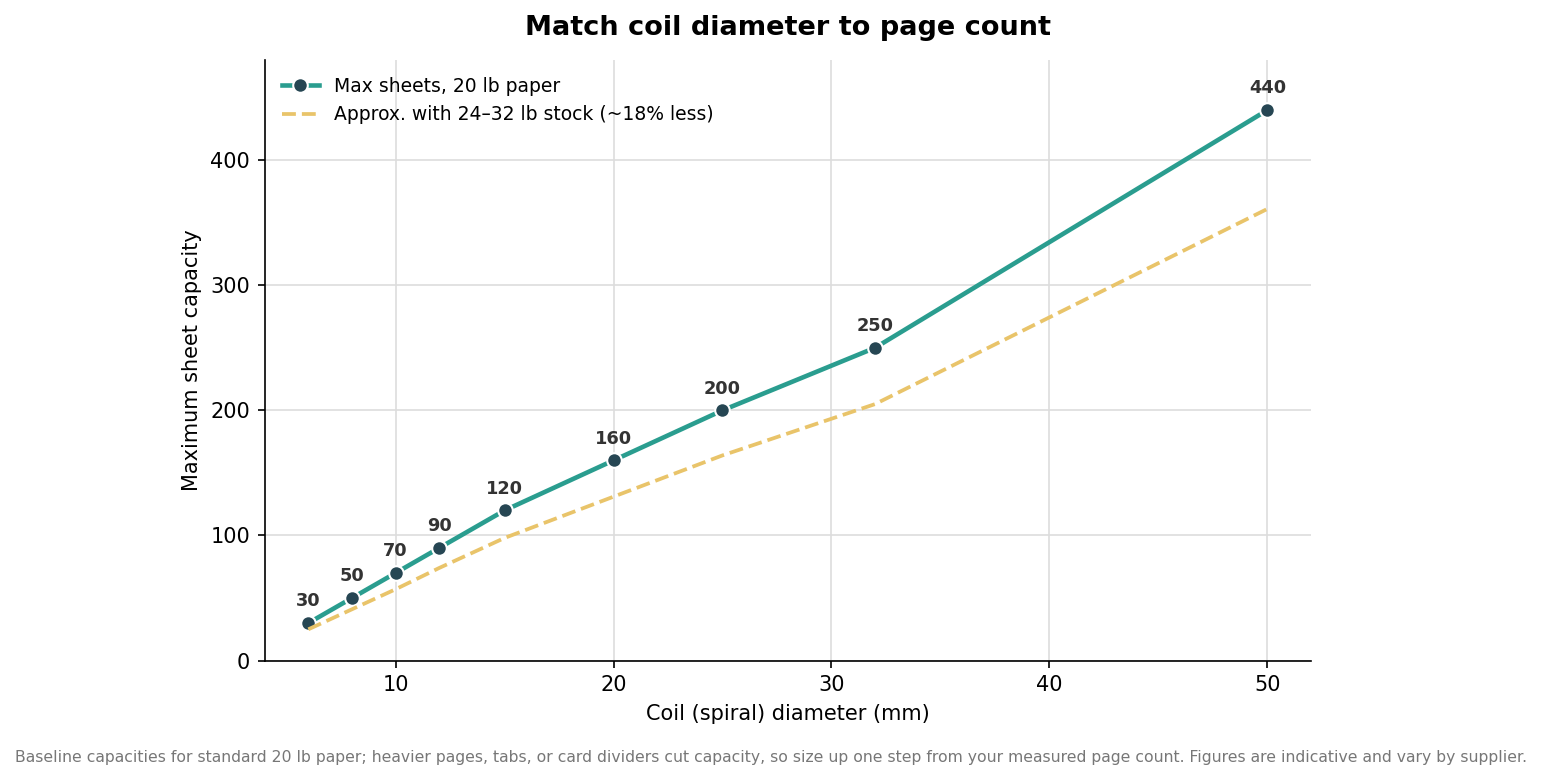
The number that trips people up is that capacity assumes light paper. Heavier stock, tab dividers, or a laminated card cover eat into the count, typically cutting a coil’s capacity by something like fifteen to twenty percent when you move to 24 or 32-pound pages. The safe method is to count your sheets, add the cover and any dividers, and then choose the next diameter up from the point where your total lands on the baseline curve. A 100-page notebook on standard paper is comfortable in a 12 to 15-millimeter coil; the same page count on premium 100 GSM paper is happier in the next size up. When in doubt, size up, because a coil with a little room turns pages freely while a maxed-out coil binds and strains at the punch holes.
Putting the spec together
A complete, unambiguous notebook spec reads as a short set of numbers: page weight in GSM, page count, interior format, cover and back weight in GSM with finish, and coil diameter in millimeters with color. Handing a supplier that removes the guesswork that produces disappointing samples. Before you commit to a full run, request a physical dummy built to those exact numbers, write in it with the pens your users will use, and close and flex it a few times. Feeling the real paper weight and the real coil fit in your hand is the last and most reliable check, and it costs far less than reprinting thousands of notebooks that turned out a size off. Get the paper and the coil right, and the cover art you spent all that time on sits on a book that actually feels worth keeping.