Most of the attention on a custom spiral notebook goes to the cover, but the interior is what people actually live with. Line spacing, subject dividers, sheet count, and where the perforation sits determine whether the notebook gets used every day or abandoned in a drawer. If you are ordering custom spiral notebooks for a school, a team, or a promotional run, the ruling you pick is not a cosmetic detail; it decides who finds the pages comfortable to write on. This is a guide to choosing the inside of the book.
What “college,” “wide,” and “narrow” actually measure
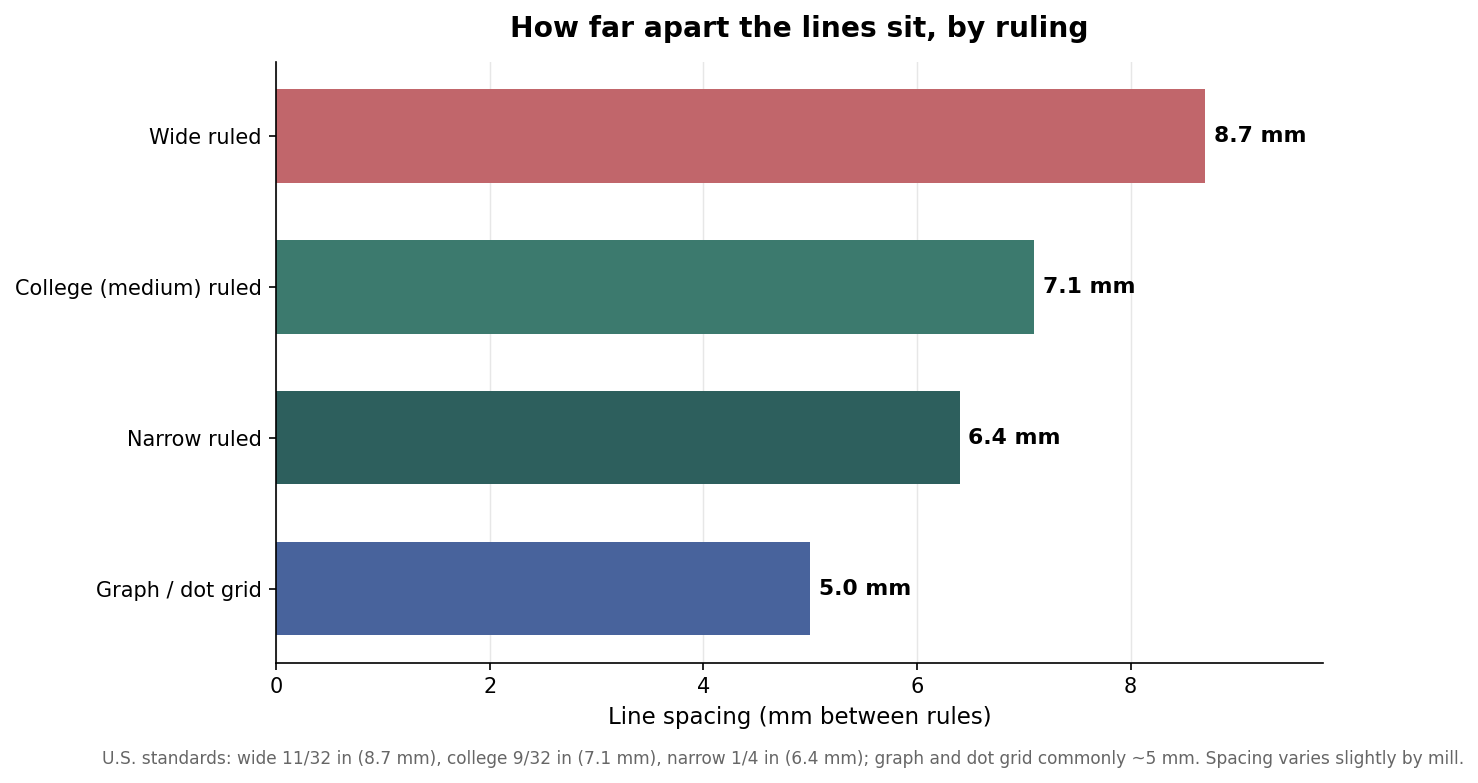
Ruling names describe one thing: the distance between the horizontal lines. In the U.S. standards, wide ruled sits at about 8.7 millimeters, or 11/32 of an inch, between lines. College ruled, sometimes called medium ruled, is tighter at roughly 7.1 millimeters, or 9/32 of an inch. Narrow ruled squeezes the lines to about 6.4 millimeters, a quarter inch. Grid formats work differently: graph and dot grid pages commonly use a 5-millimeter cell, giving you both horizontal and vertical guidance. Those few millimeters do not sound like much, but across a full page they change how many lines you get and how large a hand the paper suits.
Match the ruling to who is writing
The right ruling depends entirely on the writer. Wide ruled is the standard for younger students and anyone with larger handwriting, because the extra room prevents letters from colliding with the lines above and below. It is the safe default for elementary-age giveaways and youth programs. College ruled is the workhorse for high school, university, and professional note-taking, where fitting more lines per page matters and handwriting has settled into a smaller, faster form. Narrow ruled serves people who write small or who need maximum lines per page, such as list-heavy planners and lab settings, though it feels cramped to a lot of writers, so treat it as a deliberate choice rather than a default.
Grid formats have moved well beyond engineering. Graph and dot grid pages suit bullet journaling, sketching, hand-drawn tables, and any STEM work with diagrams or coordinate plotting. Dot grid in particular has become popular for custom planners because the dots guide alignment without the visual heaviness of full graph lines. If your audience skews creative or technical, a dot grid interior can be the feature that makes the notebook worth keeping.
One advantage of a custom run that stock notebooks cannot match is mixing rulings across sections. A multi-subject book can pair college-ruled pages for notes with a graph or dot grid section for diagrams and a blank section for freehand work. For a sales team, that might mean lined meeting notes up front and a grid section for sketching account maps; for a classroom, lined pages with a graph section for math. If you are already paying for dividers, varying the ruling behind them costs little and makes the book far more versatile.
How many subjects, and how many sheets
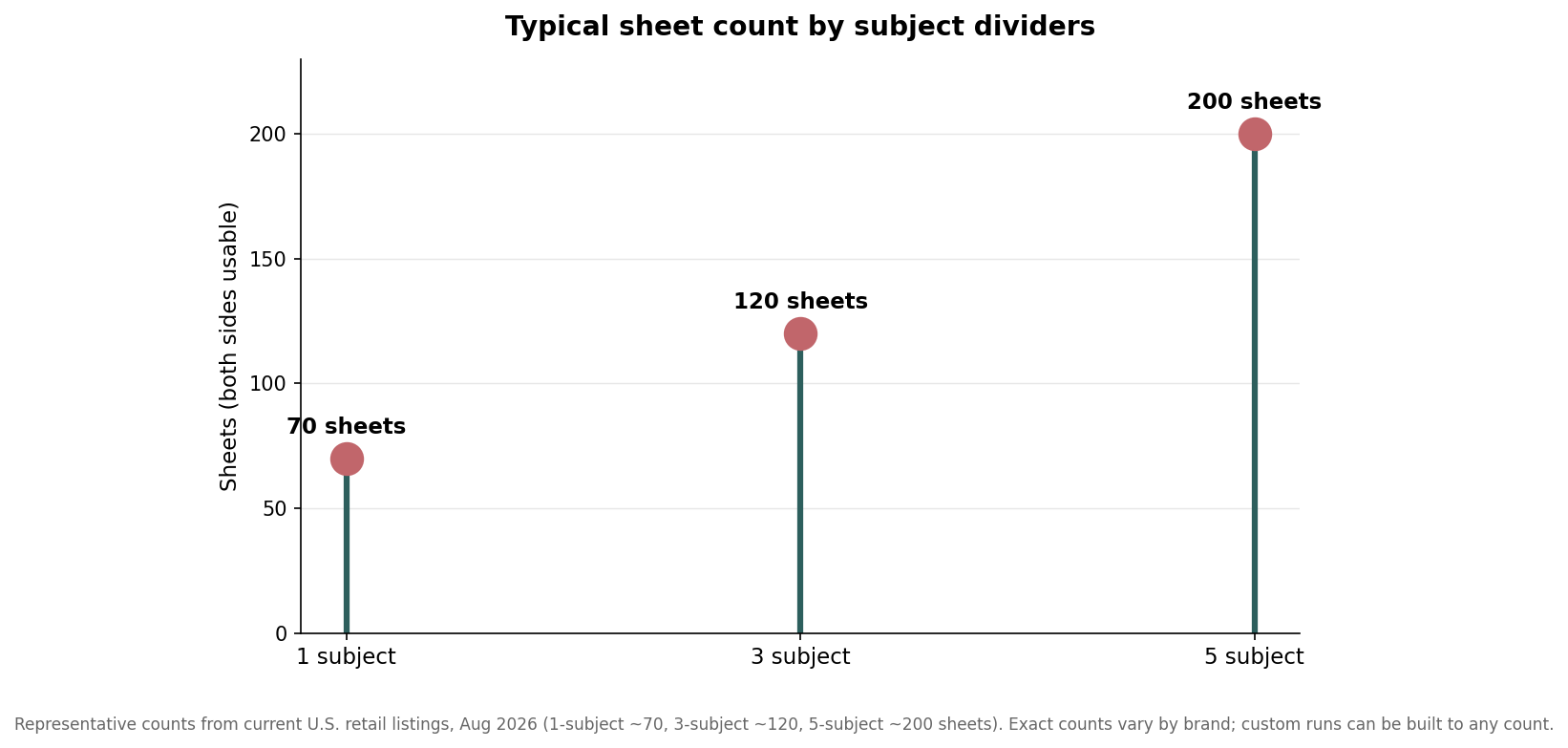
Subject dividers turn a single notebook into several. A one-subject notebook typically runs around 70 sheets and is the compact, everyday option. A three-subject book lands near 120 sheets with plastic or printed dividers separating the sections, and a five-subject notebook commonly reaches roughly 200 sheets, which is why it is the classic all-semester book. Remember that a sheet is two writing sides, so a 200-sheet notebook offers about 400 pages of writing surface. Those are representative counts from stock retail products; a custom run can be built to almost any sheet count you specify, within what the binding can physically hold.
Sheet count interacts with two other decisions. Heavier paper reduces show-through but adds bulk, so a high sheet count on thick stock can outgrow a given coil diameter. And more subjects mean more dividers and tabs, which add cost and thickness. If your users only ever need one section, do not pay for a five-subject build; if they are students juggling several classes, the dividers are the whole point.
Margins, perforations, and tear-out
Two interior details quietly decide how usable the notebook is. The first is the margin: a printed vertical rule near the binding edge keeps writing clear of the coil and gives a clean zone for dates or headings. For left-handed writers, a right-side margin option is worth considering, because a top-bound or thoughtfully laid-out page keeps their hand off the spiral. The second is perforation. Micro-perforated sheets tear out cleanly along a straight edge, which matters if pages will be handed in or filed. If the notebook doubles as a binder feeder, specify three-hole or seven-hole punching so torn sheets drop straight into a ring binder without a separate punch step.
Paper weight belongs in this conversation too. Notebook filler stock commonly falls in the range of roughly 70 to 100 grams per square meter. Toward the lighter end you get more sheets in a slimmer book but more show-through; toward the heavier end the writing side stays cleaner under fountain pen or marker, at the cost of thickness the coil has to accommodate. Pick the weight to match the writing instrument your audience actually uses.
Building the interior spec
Put the interior on paper before you approve anything: the ruling and its line spacing, whether you want lined, graph, dot grid, or a mix across sections, the number of subjects and sheets, the margin style, and the perforation and punching. Order a physical dummy and write on it with the pen your customers will use, because a ruling that looks fine on screen can feel wrong under an actual hand. Get the inside right and the cover has something worth protecting; get it wrong and the best-printed cover in the world still ends up unused.